Homeowners planning a garage upgrade in Upstate New York know that for five months of the year, every car pulling into the bay brings snow, slush, rain, and liquid road brine with it. That leads straight to one of the most important safety questions we hear during estimates: are epoxy garage floors slippery when wet, and how do you keep a glossy, easy-to-clean floor from turning into a skating rink in January?
The honest answer is that a completely smooth, un-textured resin coating is slippery when water or oil sits on top of it, because a sealed coating is 100% non-porous. Unlike bare concrete, which absorbs water into its capillaries, a coated slab holds every drop of water on the surface. However, you do not have to choose between a porous concrete slab and a slick floor. By choosing a broadcast system and tailoring the traction additive in the clear topcoat, we can dial in the exact level of grip your space needs without making the floor hard to mop.
How Our Four Floor Systems Rank for Wet Traction
Because we install four distinct resin builds across residential garages, basements, and commercial spaces, here is how each system behaves underfoot when wet, ranked from highest grip to smoothest finish:
1. Colored Quartz Broadcast with Clear Polyaspartic Topcoat (Highest Grip)
When wet-weather footing and heavy abrasion resistance are the top priorities, quartz epoxy flooring is our premium upgrade over flake. After diamond grinding the concrete and repairing cracks flush with two-part flexible epoxy, we apply a 100% solids moisture vapor barrier (MVB) epoxy base coat, broadcast hard colored silica quartz granules into the base, and seal the floor with a clear polyaspartic topcoat. Because quartz granules are angular, multi-faceted mineral grains rather than flat chips, they create a consistent micro-textured profile that grips rubber boot soles even in wet garages, wash bays, kennels, and commercial kitchens.
2. Decorative Flake Broadcast with Clear Polyaspartic Topcoat (Balanced Everyday Grip)
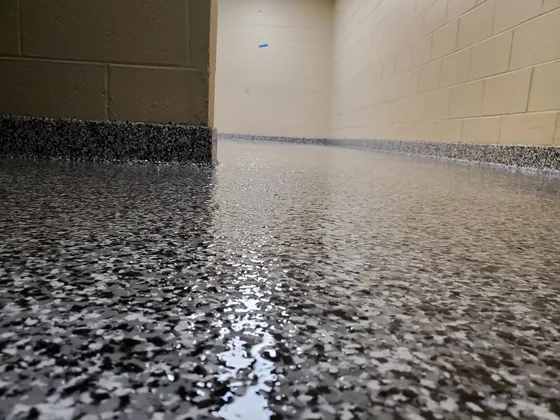
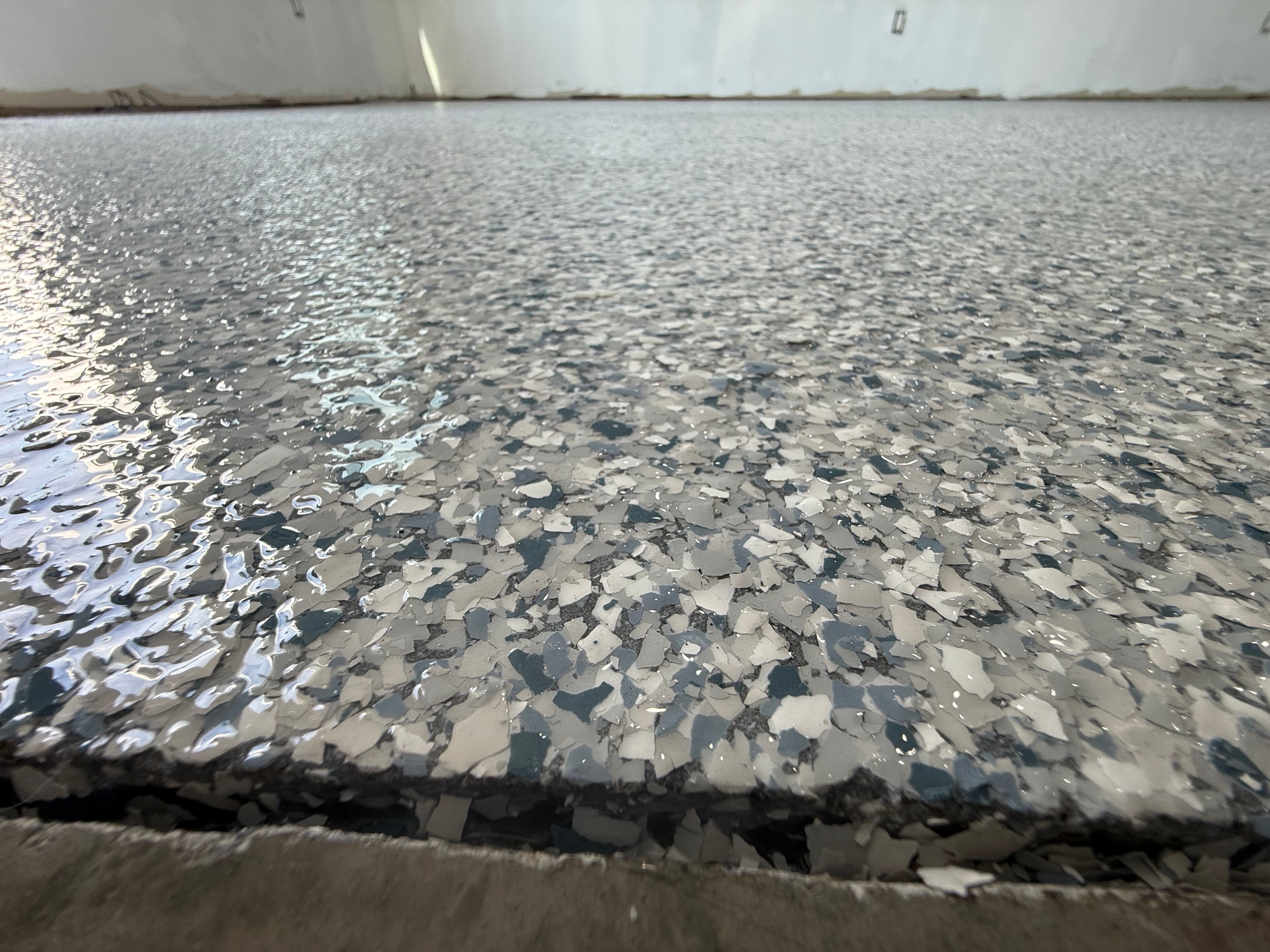
Our standard residential garage floor coating pairs the same 100% solids MVB epoxy base with a broadcast of decorative vinyl chips and a clear UV-stable polyaspartic topcoat. Once the cured broadcast is scraped flat and sealed, flake epoxy flooring retains a subtle “orange-peel” contour where the edges of the flakes sit beneath the clear topcoat. For most flat residential garages and basements, that natural flake texture gives comfortable footing with wet sneakers or snow boots while still allowing a foam squeegee or microfiber mop to glide smoothly across the floor.
3. Solid-Color 100% Solids Epoxy with Urethane Topcoat (Custom Aggregate Needed for Wet Bays)
When a customer prefers a uniform solid color (built with two to three coats of 100% solids epoxy and finished with a protective urethane topcoat), the un-broadcast film cures smooth by default. For any solid-color garage bay, shop floor, or entry ramp that will see wet boots or snowmelt, we mix traction aggregate into the urethane topcoat so the finished surface has dependable mechanical bite.
4. Metallic Epoxy with Clear Polyurea Topcoat (Dry Interiors Only)
Our custom metallic epoxy floors are built with 100% solids epoxy base layers, hand-worked metallic pigment coats, and a clear polyurea topcoat applied by sprayer or dry-mop method that cures to a glass-like high-gloss finish. Adding grit to a metallic topcoat would cloud the three-dimensional mirror depth that customers choose metallic epoxy for in the first place. Because that glass-like surface can be slick when wet, we recommend metallic systems strictly for dry interior feature spaces such as finished basements, bars, offices, and showrooms rather than wet vehicle bays.
Adding Aluminum Oxide for Extra Winter Grip
Even on a full-broadcast flake or quartz floor, certain spots in an Upstate New York garage see heavier water and foot traffic than the rest of the room: the sloped apron right inside the overhead garage door, the path from the driver’s door to the house entry step, and commercial work lanes.
Whenever a customer wants extra slip resistance on a flake or quartz system, we mix fine aluminum oxide directly into the clear polyaspartic topcoat. Aluminum oxide is an extremely hard, translucent mineral grit that suspends evenly in the clear topcoat without hiding your flake or quartz colors underneath. During your free on-site estimate, we ask how you use your garage, check whether the slab slopes toward the door, and help you choose between standard broadcast texture and an aluminum oxide traction boost.
Why Winter Brine Film Can Make Any Floor Feel Slick
One winter detail catches many New York homeowners by surprise: liquid magnesium chloride and calcium chloride road brines sprayed on highways before snowstorms are hygroscopic, meaning they attract moisture from the air and leave a slightly oily film even after snowmelt puddles evaporate. If that brine residue builds up over several weeks, it can coat the micro-texture of your floor and make it feel slicker than plain water.
Keeping your floor’s built-in grip working at 100% takes just two simple habits:
- Squeegee out slush puddles promptly: Push melted snow and road salt out the garage door with a soft foam squeegee.
- Wash away brine film with Dawn dish soap: Mop or scrub the floor with warm water and a few drops of mild Dawn dish soap using a soft deck brush, then rinse and squeegee dry. Never use Pine-Sol, vinegar, citrus cleaners, or waxy floor polishes, which leave a slippery film or dull the clear topcoat.
Test Finish Textures In Person Across Our Service Area
Our crew installs slip-resistant flake, quartz, and commercial floor systems across Greene County, Albany County, Columbia County, Schoharie County, Ulster County, and Dutchess County. Request a free quote and we will bring physical finish samples to your on-site estimate so you can feel the texture options firsthand.