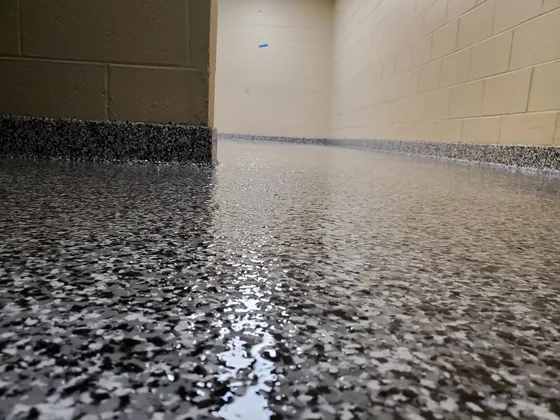

Facility managers and building owners researching warehouse concrete sealing or looking for a warehouse concrete polishing contractor are often dealing with the same underlying issue: an unsealed concrete slab that constantly sheds fine gray dust onto boxed inventory, shelving, and packing stations. In a dry storage building, distribution room, or commercial back-of-house space, a full multi-layer resinous coating is not always the only path forward. Depending on the condition of your concrete and the traffic in your aisles, sealing the slab, mechanically polishing the concrete, or installing a multi-layer epoxy system each solve different operational problems.
Because Next Level Epoxy installs concrete sealing and clear coats, concrete polishing, and commercial floor coatings, here is how we assess dry storage, warehouse, and commercial utility slabs across the Hudson Valley and Capital District.
Start with the Warehouse Use and Existing Slab Condition
Before comparing materials, walk the floor and document how each zone of the building actually operates. In its guidance on warehouse workplace hazards and solutions and general walking-working surface rules under OSHA 29 CFR 1910.22(a)(2), OSHA emphasizes keeping workroom floors clean, dry to the extent feasible, and free of surface hazards that interfere with safe material handling and foot traffic.
When we visit a warehouse or storage building for an on-site estimate, we check the physical state of the concrete first:
- Surface dusting and porosity: Bare concrete that leaves chalky dust on shoes and pallet loads usually needs either pore-level sealing, mechanical densifying and polishing, or a film-forming coating.
- Spalling, pitting, and control joints: Forklift wheels and hard-wheeled pallet jacks punish spalled edges and open saw-cut joints. A clear sealer or polish follows the existing contour of the slab, so heavily pitted concrete may need surface repairs before finishing.
- Previous sealers, curing compounds, or paint: Any peeling warehouse aisle paint or worn membrane must be mechanically removed so the new treatment can penetrate or bond evenly.
- Moisture and slab temperature: During every estimate, we take readings with a digital moisture meter and check slab surface temperature with an infrared gun so we know what is happening beneath the surface.
When to Assess Sealing, Polishing, or a Coating
Unlike homeowner garages where winter road salt and hot commuter tires dominate the conversation (which we cover separately in our residential guide to concrete sealer vs. epoxy garage floors), a commercial warehouse decision comes down to maintenance, reflectivity, and aisle wear:
- Warehouse concrete sealing: We match the sealer to the concrete using solvent-based penetrating sealers or polyurethane (poly) sealers, and we can apply a solvent-based penetrating sealer in multiple coats to build a protective film when a slab has an odor problem or needs extra surface protection. We usually avoid acrylic sealers because they do not last as long. Sealing is a practical option to evaluate when the concrete is structurally sound and the primary goal is stopping concrete dust and simplifying sweeping in dry storage zones.
- Commercial concrete polishing: We offer both residential and commercial concrete polishing, which mechanically grinds and refines the slab itself into a smooth, dense, low-maintenance surface with no topical coating to peel or recoat. Polished concrete works well in dry warehouses, retail stockrooms, and showrooms where the existing slab is in good enough shape to be exposed.
- Multi-layer 100% solids epoxy systems: When a workspace needs chemical spill protection, color-coded work zones, or a thicker wear layer that hides patched concrete, we evaluate our commercial coating systems: solid-color 100% solids epoxy (two to three coats with a urethane topcoat and optional traction aggregate), flake epoxy flooring, or quartz epoxy flooring over a 100% solids moisture vapor barrier (MVB) epoxy base with a clear polyaspartic topcoat. For adjacent offices and staff restrooms, see our Catskill commercial office and bathroom project in Tidal Wave flake.
Questions About Traffic, Racks, Joints, and Stored Materials
During the on-site walkthrough, we ask facility managers to share the exact equipment and loads that cross the slab every day:
- Material-handling traffic: Do your aisles carry foot traffic and hand carts, walkie pallet jacks, or sit-down counterbalanced forklifts? Hard polyurethane pallet-jack wheels and tight forklift turning radiuses create very different shear and point loads than foot traffic.
- Racking and anchored equipment: Are pallet racks already bolted down, or are you finishing an empty shell before racking is installed? Coating or polishing an open floor before racks go in is always simpler than cutting around hundreds of upright footplates.
- Stored liquids, batteries, or chemicals: Tell the estimator if fork-truck battery charging stations, oils, or packaged chemicals are stored on the slab so we can factor chemical exposure into the evaluation.
Food Storage Requires a Separate Requirements Check
Not every warehouse is an unregulated dry-goods building. If your facility stores, refrigerates, or distributes packaged or unpackaged food or beverages in New York, your operation may fall under New York State Department of Agriculture and Markets food-business licensing and sanitation oversight or federal food-facility rules.
Before choosing a sealer, polish, or coating for a food warehouse, cold-storage room, or beverage distribution space, verify with your inspector or food-safety lead which floor cleanability, drainage, and ventilation rules apply to your license. We never claim that a general warehouse sealer or coating automatically satisfies a food-storage regulation; your regulator makes that call.
Plan Inventory Moves, Access Routes, and Work Zones
Whether you choose concrete sealing, polishing, or a multi-layer epoxy coating, the work area must be cleared of pallets, cardboard, and traffic while the crew grinds, applies material, and lets the surface cure. For coated systems, flake and quartz builds require 2 to 3 days minimum on site, and solid-color or metallic builds require 4 to 5 days minimum on site, with repairs or moisture mitigation adding time.
When planning your project, map out how pallets will be relocated, how active shipping doors and pedestrian walkways will stay separated from the work zone, and what cure interval is required before pallet jacks or forklifts roll back onto the finished section. Never apply residential passenger-car drive-on times to forklifts or heavy pallet loads.
Request an On-Site Warehouse Floor Assessment
Next Level Epoxy is based in Coxsackie, NY, is fully insured in New York State, and serves commercial buildings across Greene County, Columbia County, Albany County, Schoharie County, Ulster County, and Dutchess County.
To walk your slab, test moisture and surface temperature, and compare sealing, polishing, and coating options for your building, contact Next Level Epoxy for a free on-site estimate, with your quote the same day.