When shop owners and facility managers look into auto repair shop floor coatings, they are trying to solve practical daily headaches: bare concrete that dusts onto clean parts, oil and coolant stains that never scrub out, dark bays that absorb overhead light, and slick patches where winter snowmelt drips off customer vehicles. At the same time, a commercial repair bay faces much tougher conditions than a homeowner garage. Rolling tool chests, floor jacks, two-post and four-post lifts, constant vehicle turnover, and shop chemicals mean a coating project has to start with a thorough on-site assessment rather than a generic sales pitch.
Here is how Next Level Epoxy evaluates commercial floor coatings for working service bays, alignment and detailing bays, and customer-facing shop spaces across the Hudson Valley and Capital District.
Assess Service Bays Separately from Reception and Parts Storage
An automotive facility rarely needs the exact same floor treatment in every room. Breaking your building into functional zones keeps the project practical and helps match the surface build to the actual workload:
- Active wrenching and maintenance bays: These slabs deal with vehicle movement, rolling toolboxes, dropped hand tools, road salt brine in winter, and routine degreasing. Under federal workplace rules in OSHA 29 CFR 1910.22(a)(2), walking-working surfaces must be kept clean and, to the extent feasible, in a dry condition. A sealed, non-porous coating with appropriate traction texture makes daily squeegeeing and cleanup far easier than porous bare concrete.
- Wet wash and detailing bays: Spaces that see continuous water spray and car-wash soaps need higher wet traction and careful attention to floor drains and slopes.
- Parts rooms and dry storage: Dry storage areas with shelving and hand carts may be candidates for concrete sealing and clear coats or concrete polishing when a simpler dust-proofed slab fits the budget and use.
- Customer waiting rooms, offices, and restrooms: Front-of-house areas need a clean, welcoming appearance that mops up quickly after muddy boots. You can see an example of how our Tidal Wave blend looks in a business support setting on our Catskill commercial office and bathroom flake floor project page.
Compare Solid-Color, Flake, and Quartz Options for the Actual Work
Within our confirmed service menu, we evaluate three primary multi-layer coating builds for automotive and commercial shop spaces:
- Solid-color 100% solids epoxy with a urethane topcoat: Our solid-color commercial build starts with heavy mechanical surface preparation, followed by two to three coats of 100% solids epoxy and a protective urethane topcoat. Light-reflective gray or tan solid colors make it easy for technicians to spot dropped fasteners or fluid drips underneath a vehicle on a lift, and traction aggregate can be mixed into the urethane topcoat where extra grip is needed.
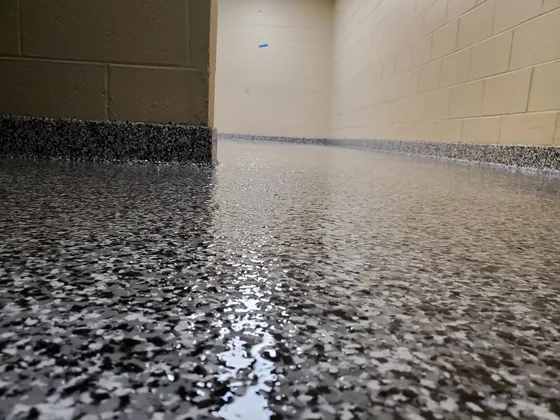
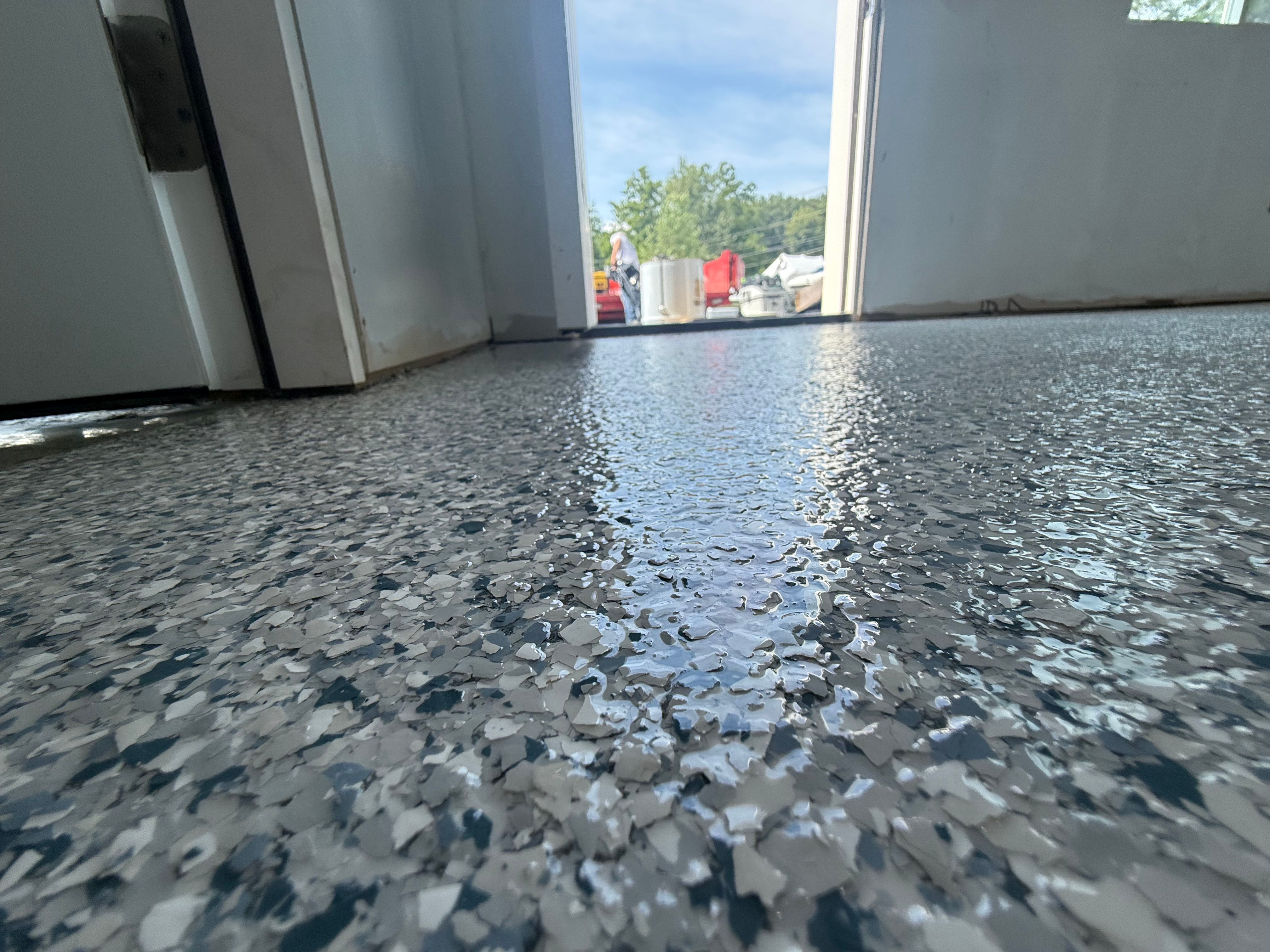
- Full-broadcast vinyl flake with a clear polyaspartic topcoat: Our flake epoxy flooring system pairs a 100% solids moisture vapor barrier (MVB) epoxy base coat with a full broadcast of decorative vinyl flake and a clear polyaspartic topcoat. The mottled flake pattern hides minor tire marks and surface dust between washdowns, while aluminum oxide can be added to the topcoat in wet lanes.
- Colored quartz broadcast with a clear polyaspartic topcoat: We position quartz epoxy flooring as our premium option relative to flake for wet and heavy-use zones, such as wash bays or heavy-duty work areas that benefit from broadcast quartz granules locked under a clear polyaspartic topcoat.
We also offer hot-tire rated topcoat options that can be selected for a specific job where warm tires pull directly into the bay. Remember that not every decorative finish shares the same tire or impact profile, which is why we review your exact vehicle traffic before specifying the topcoat.
Disclose Fluids, Lifts, Jacks, Tires, and Existing Contamination
As the U.S. Environmental Protection Agency notes in its guidance on motor vehicle service fluids, vehicle maintenance bays routinely encounter motor oil, transmission and brake fluid, antifreeze, degreasers, and solvents. While a sealed floor helps keep spills on the surface for prompt cleanup rather than letting them soak into bare concrete, a floor coating is never a substitute for proper spill containment and waste handling.
During our on-site walkthrough, tell our estimator about every condition the floor will face:
- Automotive fluids and shop cleaners: List the oils, brake fluids, battery acids, parts-washer solvents, or floor degreasers used in your bays, and wipe up chemical spills promptly during daily operations.
- Steel floor jacks, jack stands, and vehicle lifts: Point out existing two-post or four-post lift columns, anchor bolts, and areas where steel-wheeled floor jacks pivot under load.
- Years of soaked-in oil or old shop paint: Concrete that has absorbed decades of petroleum drips requires careful inspection. As we explain in our guide on why floor coatings peel, any oil or failing paint left in the slab pores can block a mechanical bond.
What Moisture Checks and Surface Assessment Establish
Every commercial estimate we perform is free and conducted on site, with your quote delivered the same day. During that visit, we measure the bays, take readings across the slab with a digital moisture meter, and check the concrete surface temperature with an infrared gun.
When we prepare a qualified slab, we mechanically diamond grind the concrete to open a clean mechanical profile and repair eligible cracks and spalls with a two-part, fast-cure epoxy crack filler that stays flexible and is ground flush before the base coat goes down. Unless a slab is brand new with a confirmed under-slab vapor barrier or radiant heat, our flake and quartz builds use a 100% solids moisture vapor barrier (MVB) epoxy base coat. Keep in mind that moisture testing and crack filling address surface readiness and vapor drive, not structural slab engineering under heavy vehicle lifts.
Plan Bay Access and Vehicle Relocation
Coating a working shop requires realistic scheduling. Our flake and quartz systems take 2 to 3 days minimum on site, and our solid-color and metallic systems take 4 to 5 days minimum on site, with heavy degreasing, old coating removal, crack repairs, or moisture mitigation adding time.
Because vehicles, toolboxes, and parts racks must stay completely off the floor during preparation, application, and curing, plan ahead for whether you will close the shop during a scheduled maintenance window or isolate a group of empty bays at a time. Do not assume residential passenger-car cure times apply to commercial lifts, heavy trucks, or steel-wheeled shop equipment; we review the return-to-service schedule for your specific bay setup during the estimate.
Request an On-Site Service-Bay Assessment
Next Level Epoxy is based in Coxsackie, NY, is fully insured in New York State, and serves repair shops, detailing bays, and commercial garages across Greene County, Columbia County, Albany County, Schoharie County, Ulster County, and Dutchess County.
Ready to have your shop bays inspected and measured? Contact Next Level Epoxy to schedule a free on-site estimate, with your quote the same day.