
One of the most common calls we get across the Hudson Valley and Capital District comes from homeowners whose garage floor was painted or coated a year or two ago and is already flaking off in sheets. Understanding why garage floor epoxy peels comes down to physics and chemistry: concrete is porous, damp, and constantly moving with New York’s seasonal temperature swings, and a floor coating will only stay bonded if the slab is mechanically opened and sealed with the right resin build.
When a coating lifts along the tire tracks or blisters in the middle of the bay, the problem almost always started before the first roller ever touched the floor. Here are the five main causes of coating failure we see in the field and how professional preparation prevents them.
The Five Most Common Reasons Garage Floor Coatings Peel
1. Weak Surface Preparation (Skipping Mechanical Grinding)
Smooth, power-troweled garage concrete has a tight surface crust called laitance, along with microscopic dust that blocks adhesion. Many DIY kits and budget painters rely on a quick pressure wash or a sprinkler-can acid etch. Acid etching rarely opens dense concrete evenly, does nothing to cut through grease or old sealers, and saturates the slab with water that can take days to dry out. Without mechanical diamond grinding to physically open the concrete pores, the coating sits on top of the slab like tape on a dusty table.
2. Moisture Vapor Pushing Up Through the Concrete
Concrete slabs act like a hard sponge sitting on damp soil. In river-town and valley communities across Greene, Columbia, and Ulster counties, spring snowmelt and seasonal water tables create hydrostatic vapor pressure underneath uninsulated garage and basement slabs. As that moisture vapor rises through microscopic capillaries in the concrete, it hits the underside of a non-breathable paint film and pushes it upward into bubbles, blisters, and peeling sheets.
3. Hot-Tire Pickup and Low-Solids DIY Paint Kits
Water-based hardware-store “1-part epoxy” paints and low-solids consumer kits cure into a thin film as the water or solvent evaporates. When you drive home on the Thruway or Route 9W, your tires heat up. Parking hot rubber on a low-grade film softens the resin; as the tire cools and contracts, it welds itself to the weak paint and rips strips of coating off the slab the next morning.
4. Oil, Silicone, Curing Compounds, and Surface Contamination
Garage slabs collect motor oil drips, power-steering fluid, tire-shine overspray, road grime, and sometimes invisible curing sealers sprayed on the day the concrete was poured. Degreasers alone cannot pull soaked-in petroleum or silicone out of unground concrete pores, so any coating rolled directly over those spots will fisheye or delaminate.
5. Coating Outside the Proper Temperature Window
Two-part resins rely on a chemical reaction that is sensitive to concrete slab temperature, which is often much colder than the air temperature on a crisp New York morning. If a coating goes down on concrete that is too cold or damp with condensation, the resin cures sluggishly or fails to wet out into the pores, leaving a brittle bond.
How to Tell Hot-Tire Pickup Apart from Sub-Slab Moisture Blistering
You can usually spot what caused a garage floor to fail by looking at where the peeling starts and what the concrete looks like underneath:
- Hot-tire pickup: Failure is restricted almost exclusively to the four tire resting spots where vehicles park after highway driving. The lifted flakes often cling to the tire tread or curl along the edges of the tire path, while the concrete exposed underneath looks dry and dusty.
- Sub-slab moisture blistering: Domes, bubbles, or flaking patches show up randomly in the center of the bay, along foundation walls, or beneath rubber mats and storage totes where tires never roll. If you pry up a fresh blister, the concrete pocket underneath often looks dark and damp or shows a chalky white mineral ring left by evaporating groundwater.
How We Prepare Concrete Before Coating in the Hudson Valley
When we install garage floor coatings in Greene County, NY, our crew spends more time preparing the concrete than rolling on the finish coats. Whether the job is right here in Greene County, across the river in Columbia County, or south into Ulster County, every project follows the same preparation sequence:
- Moisture and slab temperature testing: Every free on-site estimate includes a digital moisture meter test across the slab. In spring and fall, we also check the concrete with an infrared thermal temperature gun to confirm the surface is above 40 degrees F before any coating is scheduled.
- Mechanical diamond grinding: We grind the entire floor with heavy-duty diamond tooling connected to dust-extraction vacuums. Diamond grinding removes weak surface laitance, old paint, and surface oils while opening a clean, uniform mechanical tooth across the slab and along the perimeter edges.
- Flexible two-part epoxy crack and spall repair: After vacuuming the ground concrete, we fill cracks and spalled areas with a fast-curing two-part epoxy crack filler that sets hard in minutes and stays flexible with the concrete, then diamond grind every repair flush with the surrounding slab.
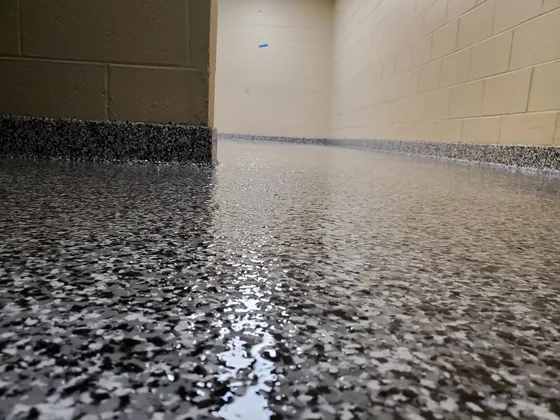
- 100% solids moisture vapor barrier (MVB) epoxy base and polyaspartic topcoat: Because garages and basements carry more ground moisture, we prime the prepared slab with a 100% solids moisture vapor barrier epoxy base coat (the only exception is a brand-new slab poured over radiant heat or an under-slab plastic vapor barrier), broadcast flake epoxy flooring chips or colored quartz into the wet base, and seal the floor with a clear UV-stable polyaspartic topcoat that stays flexible with the slab and will not yellow in sunlight.
Simple Pre-Checks Homeowners Can Do (Water-Drop and Plastic Sheet Screening)
Before we arrive for your estimate, there are two quick checks you can try on a bare garage floor:
- Water-drop absorption check: Pour a tablespoon of clean water onto several spots across the concrete. On clean, open concrete, the water should darken the surface and soak in within a minute or two. If the water beads up on top like rain on a waxed hood, an old sealer or oil film is blocking the pores and will need to be mechanically ground off.
- Plastic-sheet moisture check: Tape a 2-foot square of clear plastic sheeting tightly to the slab on all four sides and leave it for 24 hours. If water droplets form on the underside of the plastic or the concrete darkens inside the square, moisture vapor is moving up through the slab. We confirm the exact moisture condition with our digital meter during your on-site visit.
Can a Peeling Garage Floor Be Fixed?
Yes. Almost every peeling garage floor we inspect can be rescued, provided the underlying concrete slab is structurally sound. Our crew uses aggressive diamond tooling to strip the failed paint or DIY epoxy back to bare, clean concrete, repairs cracks flush, and installs a full 100% solids MVB epoxy base, flake or quartz broadcast, and clear polyaspartic topcoat. Residential garage installations include our residential warranty: Lifetime delamination and workmanship warranty, transferable to new owners. Excludes cracking and slab movement. If a slab has severe structural moisture issues where no topical coating should be applied, we will tell you up front during your estimate and can discuss alternatives such as concrete polishing.
Why You Cannot Just Scrape the Loose Spots and Recoat Over Old Paint
Homeowners often ask if we can simply scrape away the loose flakes and roll a fresh coat over the paint that still seems stuck. Unfortunately, any coating applied on top of old paint is only anchored to the old paint, not the concrete slab. Even worse, as a professional 100% solids epoxy base cures and cross-links, its bond tension will pull the weaker hardware-store paint right off the floor, creating peeling blisters and visible ridge lines around every patch. Stripping the entire floor back to bare concrete with diamond grinders is the only way to build a bond that lasts.
If your existing garage floor is peeling or you want your bare concrete prepared right the first time, request a free quote from Next Level Epoxy Inc.