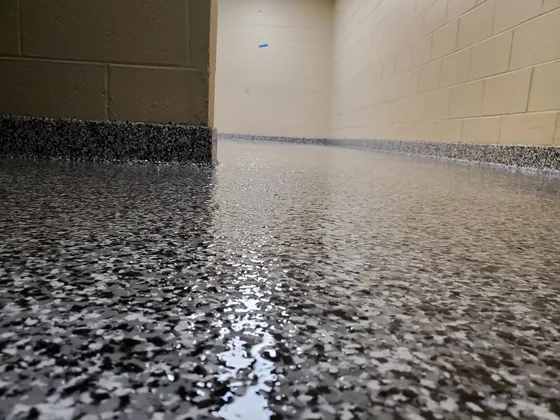

Every winter across the Hudson Valley, the Catskills, and the Capital District, cars pull into the garage carrying pounds of slush laced with highway rock salt, sand, and liquid de-icing brines. Left on bare concrete, that salty meltwater soaks into the slab and triggers surface flaking, pitting, and white mineral staining. Choosing the best garage floor coating for road salt comes down to sealing the concrete pores completely with a multi-layer resin system that will not peel under hot tires or crack during New York freeze-thaw swings.
Here is how winter de-icers attack unprotected concrete, how our multi-layer coating builds stop the damage, and what to look for when comparing finishes for your garage.
How Road Salt and Ice Melt Damage Bare Concrete
Bare garage concrete looks solid, but under a microscope it is a network of tiny capillaries and air voids left behind when the mix water evaporated. When snow and slush melt off your wheel wells, salty water wicks straight into those pores.
- Freeze-thaw hydraulic pressure: When overnight temperatures drop below freezing near the garage door, water trapped inside the top eighth-inch of concrete freezes and expands by roughly nine percent. Salt brine lowers the freezing point slightly, but it also holds more moisture in the surface zone, multiplying the number of freeze-thaw cycles the slab endures between November and April.
- Chemical scaling and spalling: De-icing salts react with calcium hydroxide in hardened cement paste and leave salt crystals behind as puddles evaporate. Over a few winters, the smooth troweled crust pops off in shallow craters known as spalling, exposing rough aggregate and shedding gray concrete dust across the garage.
- Sub-slab corrosion and staining: Chlorides that penetrate deeper into the slab corrode steel reinforcing mesh and leave stubborn rust, oil, and white efflorescence rings that no pressure washer can remove.
Rock Salt vs Calcium Chloride and Magnesium Chloride Brines
Not all winter road treatments behave the same way once they drip onto your garage floor:
- Sodium chloride (standard rock salt): The traditional granular salt spread by town and state plows works down to roughly 15 degrees F. As slush evaporates, rock salt leaves chalky white rings and gritty sand along the tire tracks.
- Magnesium chloride and calcium chloride brines: Highway crews and commercial snow contractors increasingly pre-wet roads with liquid magnesium chloride (effective down to -13 degrees F) and calcium chloride (effective down to -25 degrees F). Both of these chlorides are strongly hygroscopic, meaning they pull moisture out of the air and stay damp long after ordinary snowmelt would have dried. On bare concrete, they keep the slab chronically wet; on a coated floor, they cannot harm the resin, but they leave a slightly slick, oily-feeling film until you squeegee or rinse the floor with warm water.
Coating Systems That Stand Up to Upstate NY Winters
Single-coat hardware-store garage paints and thin water-based sealers are no match for five months of road salt, snowplow grit, and hot tires. At Next Level Epoxy, we build garage floor coatings in layers so each coat handles a specific job:
1. Flake Epoxy with a Clear Polyaspartic Topcoat (Most Popular)
Our standard residential garage build starts by mechanically diamond grinding the slab and repairing cracks flush with a fast-curing two-part flexible epoxy filler. We then apply a 100% solids moisture vapor barrier (MVB) epoxy base coat (used on garages and basements because they carry more ground moisture, except on brand-new slabs built with radiant heat or an under-slab plastic vapor barrier), broadcast decorative flake epoxy flooring chips across the floor, and lock the system in with a clear polyaspartic topcoat.
We use polyaspartic strictly as the clear topcoat rather than a standalone system because pairing the two chemistries gives you deep epoxy adhesion and moisture blocking underneath, plus a clear polyaspartic wear layer that stays flexible with the concrete and will not yellow or amber in sunlight near open garage doors.
2. Colored Quartz Broadcast with a Clear Polyaspartic Topcoat (Premium Upgrade)
For homeowners and shops that want our heaviest-duty broadcast floor, quartz epoxy flooring replaces flat vinyl chips with hard, colored silica quartz granules broadcast into the 100% solids MVB epoxy base and sealed with a clear polyaspartic topcoat. Quartz is our premium upgrade over flake, offering maximum abrasion resistance against winter sand and built-in wet-weather grip.
3. Solid-Color 100% Solids Epoxy with a Urethane Topcoat
When a customer prefers a clean, uniform solid color instead of a chip or quartz blend, we install two to three coats of 100% solids epoxy finished with a protective urethane topcoat. Traction aggregate can be mixed into the urethane topcoat, and fine aluminum oxide can be added to our clear polyaspartic topcoats whenever a bay needs extra winter slip resistance.
Why Surface Preparation Matters More Than the Topcoat
Even the toughest polyaspartic or urethane topcoat will fail if the base layer cannot grip the concrete. Across Greene County, Albany County, and Columbia County, every estimate we run includes a digital moisture meter test, plus an infrared thermal temperature gun check in spring and fall to verify the concrete is above 40 degrees F. Our crew mechanically diamond grinds the entire slab, fills cracks and salt-spalled pockets with a fast-curing two-part epoxy filler ground flush, and applies the 100% solids MVB epoxy base so salt brine can never sneak underneath the coating.
Simple Winter Habits That Help a Coated Floor Last
Once your garage floor is coated, winter cleanup takes minutes instead of hours:
- Squeegee out slush puddles: Keep a soft foam squeegee handy to push salty meltwater out the bay door.
- Rinse brine film on mild days: When calcium or magnesium chloride brine leaves a slick film, wash the floor with warm water and a few drops of Dawn dish soap using a soft nylon deck brush, then squeegee dry.
Protecting the Garage Door Threshold and Using Mats Under Snowblowers
Two spots in a New York garage deserve a little extra attention during snow season:
- Keep the garage door threshold clear: Sweep or squeegee slush piles away from the line where the rubber garage door bottom seal meets the floor. Leaving salty slush pooled against the door can freeze the rubber weatherstrip to the coating overnight and concentrates freeze-thaw stress right at the exterior slab edge.
- Park snowblowers on a heavy rubber mat: Steel snowblower skid shoes, metal auger housings, and tire chains can scratch any floor coating if they spin or drag in place. Resting your snowblower on a thick rubber mat and checking that the skid shoes are adjusted properly keeps bare steel off the clear topcoat all winter.
Ready to seal your garage concrete before the next winter salt season? Request a free quote from Next Level Epoxy Inc. for an on-site slab inspection and moisture check.