When homeowners start researching an epoxy vs polyaspartic garage floor, almost every search result frames the decision as an all-or-nothing rivalry. One contractor claims epoxy is obsolete and pushes a fast-curing all-polyaspartic floor; another argues that polyaspartic sets too quickly to bond deeply into concrete. Both pitches leave out the most practical engineering answer: epoxy and polyaspartic are two different resin families designed to do two different jobs in the same floor system.
At Next Level Epoxy, we do not ask you to pick between adhesion and UV stability. On every decorative flake epoxy floor and premium quartz epoxy floor we build, we put 100% solids moisture vapor barrier (MVB) epoxy on the bottom where it grips the concrete and blocks ground dampness, and a clear polyaspartic topcoat on top where it faces sunlight, hot tires, and winter road salt.
Here is how the two chemistries actually differ, where each material excels, and how we match base coats and topcoats across the Hudson Valley and Capital District.
What Epoxy Is vs What Polyaspartic Is
Although people casually call almost any resinous concrete coating “epoxy,” epoxy and polyaspartic belong to separate chemical families with distinct curing behaviors:
- 100% solids epoxy (epoxide resin + polyamine hardener): Professional two-component 100% solids epoxy contains no water or evaporating solvents. What we roll onto your ground concrete cures at full thickness through a chemical cross-linking reaction. Because epoxy cures at a measured pace, the liquid resin has time to soak deeply into the microscopic valleys opened up by mechanical diamond grinding. When formulated as a moisture vapor barrier (MVB) primer, 100% solids epoxy also locks down upward vapor transmission from damp ground underneath the slab.
- Polyaspartic (aliphatic polyurea ester): Developed in the 1990s as a modified aliphatic polyurea, polyaspartic reacts much faster than epoxy and cures into a crystal-clear, highly abrasion-resistant film. Because its molecular backbone is aliphatic rather than aromatic, a clear polyaspartic coating does not oxidize or turn yellow when sunlight hits the garage apron or open bay doors. It also retains slight elongation flexibility so it can move with the concrete slab through New York freeze-thaw swings.
Why “Epoxy vs Polyaspartic” Is Usually a False Choice
When a franchise or marketing site tells you that you must choose between an all-epoxy garage floor and an all-polyaspartic garage floor, they are usually selling a scheduling model rather than matching each layer to what the concrete needs.
Where 100% Solids MVB Epoxy Wins: The Base Coat
Garage and basement slabs in Upstate New York sit directly on cool, damp soil that experiences months of snowmelt and seasonal water-table shifts. When we arrive for a free on-site estimate, we test every slab with a digital moisture meter and, during spring and fall, check surface temperature with a thermal gun to verify the concrete is above 40 degrees F.
On almost every residential garage and basement floor, we start with a 100% solids moisture vapor barrier epoxy base coat. That base layer gives the floor three advantages that a fast-setting topcoat resin cannot duplicate on its own:
- Deep mechanical wetting: Epoxy’s longer working window allows the resin to penetrate the diamond-ground concrete profile and lock around the aggregate before gelling.
- Moisture vapor protection: Garages and basements carry higher ground moisture than upper-level interior slabs. Our MVB epoxy base is built to hold back sub-slab vapor drive that can otherwise blister a thin coating. The only time a garage or basement slab does not require an MVB base coat is when we are coating brand-new concrete poured over radiant heat or an verified under-slab plastic vapor barrier.
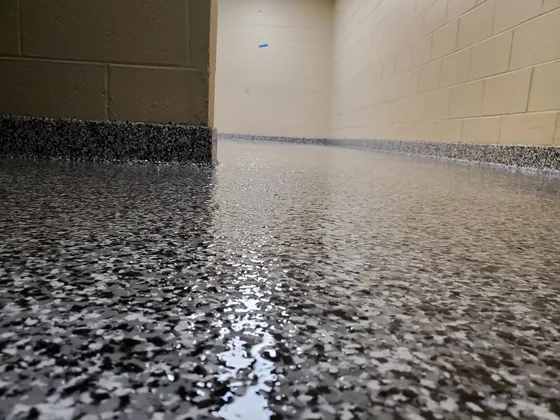
- Full broadcast embedment: A high-build 100% solids epoxy base holds a dense broadcast of vinyl flake or colored quartz granules firmly in place.
Where Clear Polyaspartic Wins: The Topcoat
While 100% solids epoxy is an exceptional structural base coat, standard epoxy has a well-known weakness when used as an unpigmented clear topcoat near windows or open garage doors: ultraviolet light gradually turns clear epoxy yellow or amber.
That is why we never leave bare epoxy exposed on a flake or quartz floor. Instead, once the broadcast is scraped and vacuumed, we seal every flake and quartz installation with a clear polyaspartic topcoat. In the topcoat position, polyaspartic delivers:
- True UV stability: The clear film stays clear where afternoon sunlight reaches inside the garage bay.
- Flexibility with the slab: Concrete expands and contracts as Upstate temperatures swing from summer heat to subzero January nights. A clear polyaspartic topcoat flexes with the slab instead of becoming brittle.
- Hot-tire and salt resistance: Paired with our epoxy base, hot-tire rated polyaspartic topcoat options resist tire plasticizer pickup, oil drips, and winter calcium or magnesium chloride road brines. When a customer wants extra wet-weather footing, we can also mix fine aluminum oxide directly into the clear polyaspartic topcoat.
How Our Four Core Coating Systems Pair Base Coats and Topcoats
Because different rooms face different traffic and lighting demands, we match the topcoat chemistry to the system you choose for your garage floor coating or interior space:
- Decorative Flake System (2 to 3 days minimum on site): Mechanical diamond grinding, two-part flexible epoxy crack repair ground flush, a 100% solids MVB epoxy base coat, full vinyl flake broadcast, and a clear UV-stable polyaspartic topcoat (with optional aluminum oxide grip).
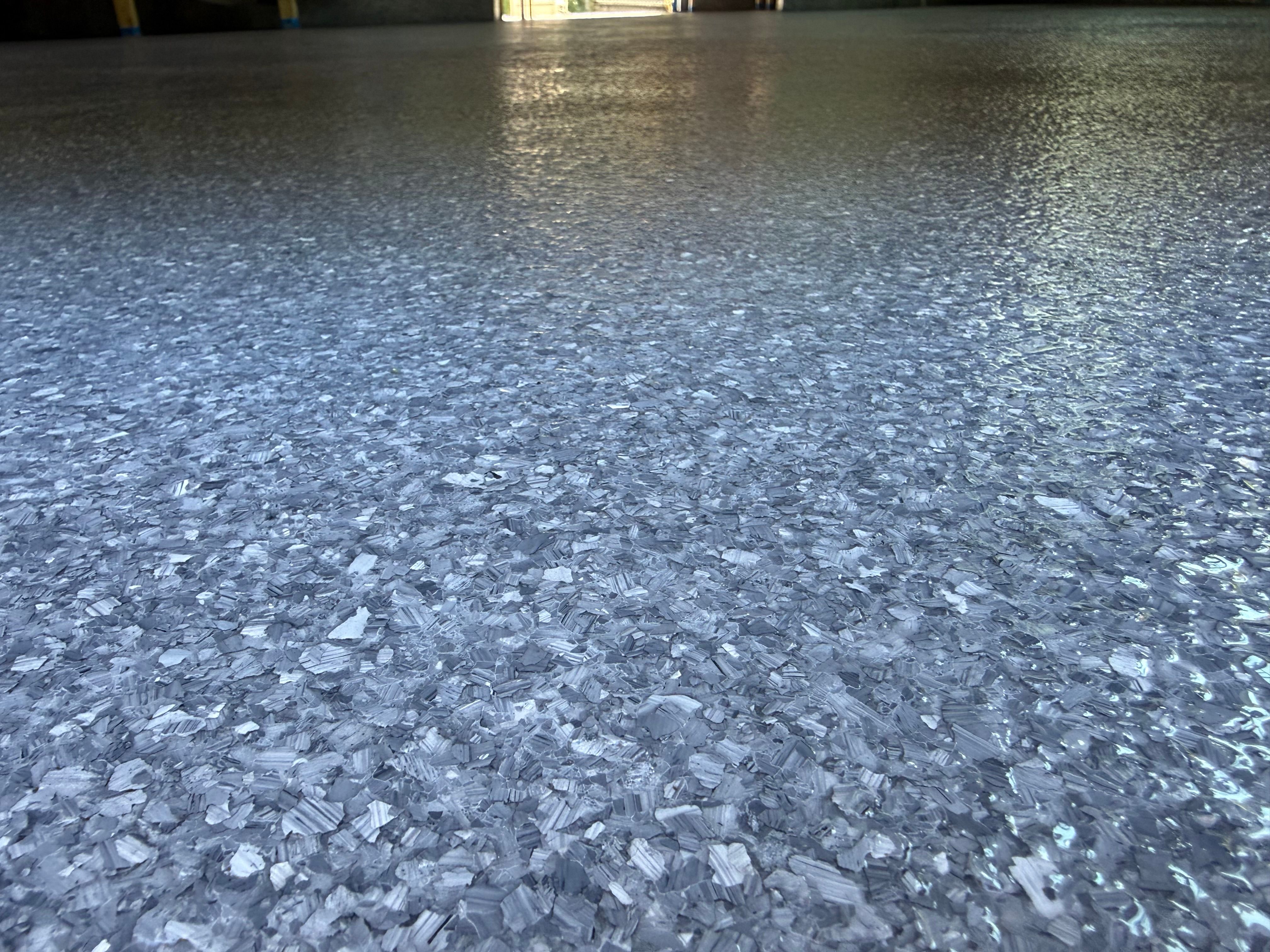
- Colored Quartz Broadcast System (2 to 3 days minimum on site): Our premium upgrade over flake, built with the same 100% solids MVB epoxy base coat, a broadcast of durable colored quartz granules, and a clear polyaspartic topcoat for heavy work bays and commercial floors.
- Solid-Color Epoxy System (4 to 5 days minimum on site): Two to three coats of 100% solids epoxy finished with a protective urethane topcoat, which can take mixed-in traction aggregate for extra slip resistance.
- Metallic Epoxy System (4 to 5 days minimum on site): 100% solids epoxy base layers and hand-worked metallic pigment layers sealed with a clear polyurea topcoat applied by sprayer or dry-mop method for a glass-like high-gloss finish in basements and showrooms.
Note that while a faster-drying one-day option is possible in certain situations, our standard multi-day schedule gives the MVB epoxy base, crack repairs, and clear topcoat the cure time they need to bond permanently. After the final topcoat on a standard garage, wait 24 hours for light foot traffic, 48 hours for light items like cabinets and toolboxes, and 72 hours before parking vehicles. Residential installations include our residential warranty: Lifetime delamination and workmanship warranty, transferable to new owners. Excludes cracking and slab movement.
Choosing the Right System for Your Garage Slab
Our crew installs multi-layer epoxy and polyaspartic garage floors across Greene County, Albany County, Columbia County, Schoharie County, Ulster County, and Dutchess County. Instead of guessing from generic internet comparisons, let us test your concrete moisture, inspect existing cracks, and show you physical flake and quartz samples in person. Request a free quote today to schedule your on-site estimate.