Homeowners finishing or cleaning up a lower level in the Hudson Valley or Capital District usually face the same dilemma: carpet traps musty odors, laminate and vinyl planks can buckle if a dehumidifier falls behind or a water heater drips, and bare concrete sheds chalky gray dust on every box and shoe. When evaluating an epoxy floor for basement concrete versus a clear concrete sealer, the best choice comes down to how you use the room, how much sub-slab moisture is moving through the concrete, and whether you want a natural concrete look or a bright, decorative finish.
Because a below-grade basement slab behaves differently from an upstairs floor, here is how clear concrete sealing compares with our multi-layer flake, metallic, and solid-color epoxy systems.
Why Below-Grade Basement Slabs Need Moisture Testing First
Unlike an upper-floor subfloor, a basement slab sits several feet below grade against cool earth. In Upstate New York, spring snowmelt, clay soils, and seasonal water-table shifts create steady upward moisture vapor pressure beneath the house. Even when a basement looks dry to the naked eye, water vapor can migrate invisibly through microscopic capillaries in the concrete.
Before we recommend a clear sealer or a full multi-layer coating, we start every basement estimate with a digital moisture meter test across the floor (and in spring and fall, we also check slab temperature with a thermal gun to verify the concrete is above 40 degrees F). Testing the slab up front tells us how much dampness the concrete is carrying and ensures we match the prep and primer to the real conditions under your home.
Option 1: Clear Concrete Sealing for Utility and Storage Basements
If your basement is primarily used for storage, a laundry area, a furnace room, or a clean workshop where you are happy with the appearance of the existing gray concrete, concrete sealing and clear coats offer a straightforward upgrade. The sealer we use depends on the concrete: we install solvent-based penetrating sealers or poly (polyurethane) sealers, and we usually avoid acrylic sealers because they do not last as long. When a basement slab has a musty or pet odor problem, we apply a solvent-based penetrating sealer in multiple coats to build a film that locks odors down. (If you are comparing these options for a vehicle bay, workshop, or pole barn, see our guide on concrete sealer vs epoxy for garage floors.)
What a Clear Sealer Does Well
- Stops concrete dusting: Unsealed concrete slowly abrades under foot traffic, releasing fine silica and cement dust. A clear sealer binds the surface pores so the floor sweeps and mops clean.
- Protects against everyday drips: Laundry detergent, water heater condensation, and household spills wipe up instead of soaking immediately into dry concrete.
- Preserves the natural slab look: Because the coating is transparent, the natural gray stone and trowel character of your concrete stays visible.
What a Clear Sealer Will Not Hide
A clear sealer is not a high-build decorative system. Any existing oil stains, dark rust rings, or patched cracks in the concrete will remain visible under a transparent coat. If your basement slab has years of discoloration, old carpet-glue ghosting, or flush-ground crack repairs that you want to cover completely, a pigmented multi-layer epoxy system is the better fit.
Option 2: Multi-Layer 100% Solids MVB Epoxy Systems
When you want to turn a basement rec room, home gym, workshop, furnace room, or lower-level apartment into a bright, finished living space, a multi-layer resin system transforms the room completely.
The Foundation: Prep and 100% Solids MVB Epoxy Base
Every basement epoxy floor we install begins with mechanical diamond grinding to strip old adhesives, paint, or efflorescence and open a clean mechanical profile. We repair cracks and surface defects with a fast-curing two-part flexible epoxy crack filler and diamond grind those repairs flush.
Next, because basements carry more ground moisture than above-grade rooms, we apply a 100% solids moisture vapor barrier (MVB) epoxy base coat (the only exception is a brand-new slab poured with radiant heat or a verified under-slab plastic vapor barrier). From that moisture-blocking foundation, you can choose three distinct finishes:
1. Decorative Flake with a Clear Polyaspartic Topcoat (2 to 3 Days Minimum)
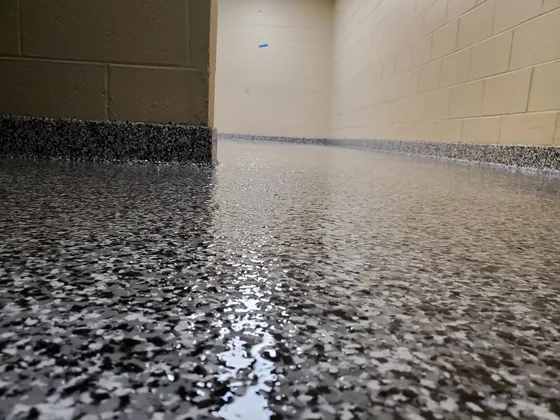
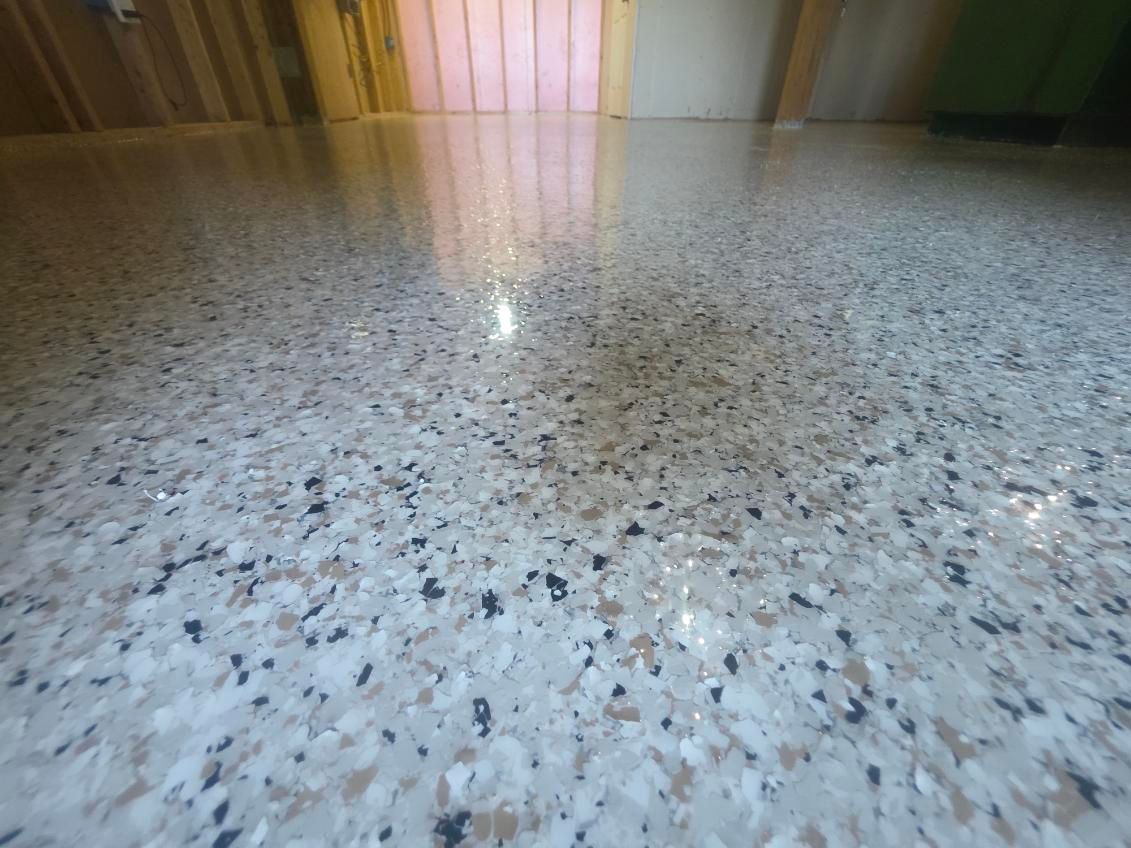
Our most versatile basement system broadcasts multi-tone vinyl chips into the wet 100% solids MVB epoxy base and seals the floor with a clear polyaspartic topcoat. Flake epoxy flooring provides gentle underfoot texture, hides flush crack repairs and everyday dust, and can incorporate fine aluminum oxide in the topcoat around laundry tubs, walkout doors, or utility sinks where floors get wet.
2. Custom Metallic Epoxy with a Clear Polyurea Topcoat (4 to 5 Days Minimum)
For finished basements, home bars, media rooms, and offices, metallic epoxy floors deliver a one-of-a-kind architectural finish (see our guide to metallic epoxy basement floor ideas). We apply 100% solids epoxy base layers followed by hand-worked color layers of 100% solids epoxy mixed with metallic powder, then seal the system with a clear polyurea topcoat applied by sprayer or dry-mop method that cures to a glass-like high-gloss finish. Because each coat cures in sequence, metallic floors take 4 to 5 days minimum on site and are best suited for dry interior rooms.
3. Solid-Color Epoxy with a Urethane Topcoat (4 to 5 Days Minimum)
For workshops, utility rooms, and clean mechanical spaces, we also install two to three coats of 100% solids epoxy finished with a protective urethane topcoat, with optional mixed-in traction aggregate for slip resistance.
Return-to-Service Timelines and Basement Care
Planning around a basement coating project is straightforward when you know the cure windows ahead of time. Once our crew finishes the final topcoat on a multi-layer basement system, allow 24 hours for light foot traffic in socks or clean shoes and 48 hours before moving light items, shelving, washers, dryers, or furniture back onto the floor (a faster-drying one-day option is possible in certain situations when slab conditions allow).
Day-to-day maintenance is equally simple: dust mop or vacuum loose grit as needed, and wash the floor with warm water and a few drops of mild Dawn dish soap using a soft microfiber mop. Avoid Pine-Sol, vinegar, or citrus cleaners that can leave a film or dull the protective topcoat.
Compare Basement Flooring Options In Person
Whether you want a simple clear-sealed utility room or a custom flake or metallic basement floor, our crew serves homeowners across Greene County, Albany County, Columbia County, Schoharie County, Ulster County, and Dutchess County. Request a free quote for an on-site moisture test and side-by-side finish samples in your basement.